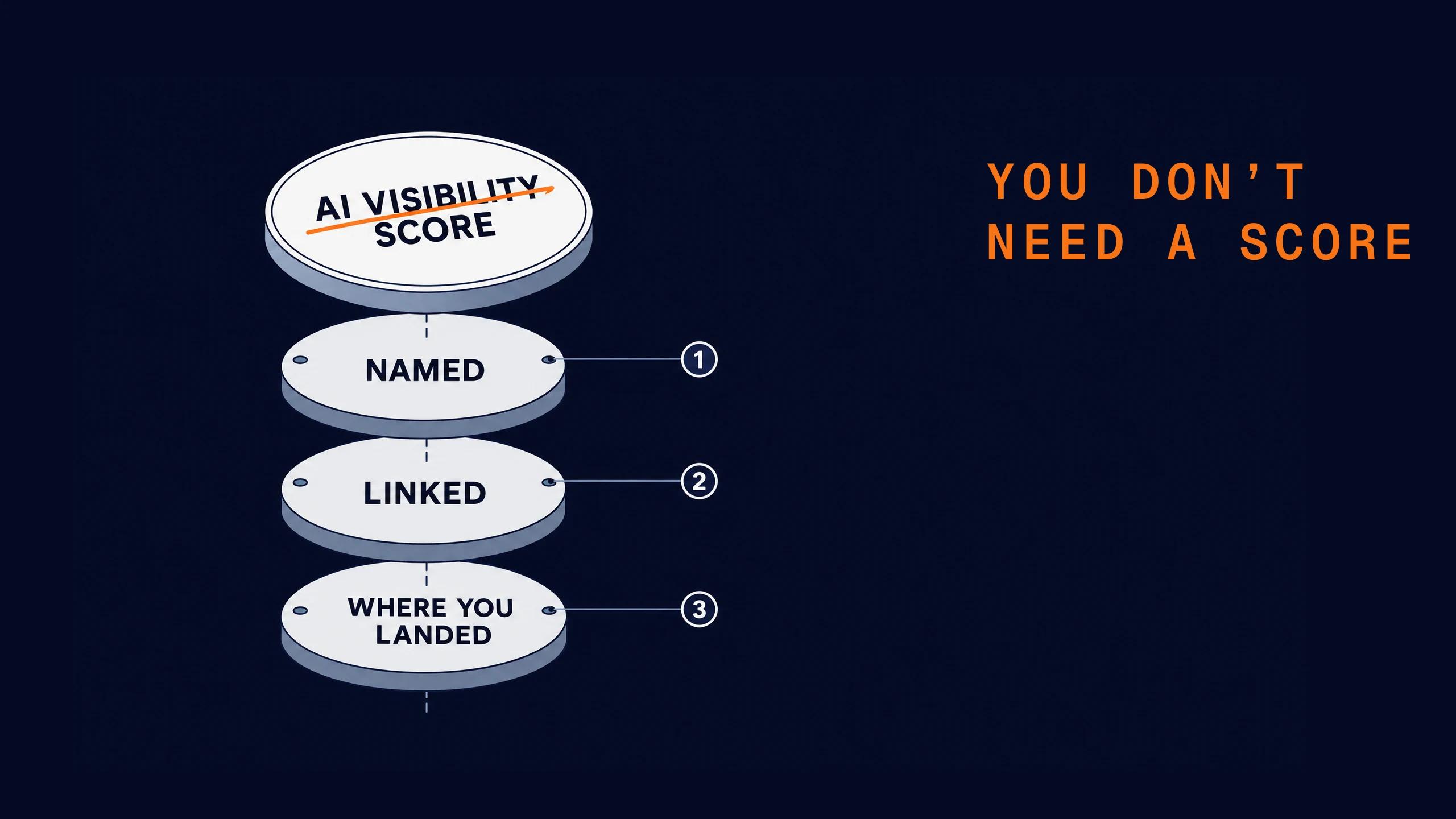
Tracking whether AI answers name your company comes down to two decisions: what you write down, and how often you go back. Seven columns and a monthly run will carry most distributors further than any dashboard. This is the record itself, column by column, and why each one earns its place.
What this is, and what it is not
Quick clarification first, because the phrase gets used two ways. This is not about managing citations in a research paper. This is about whether ChatGPT, Perplexity or Google's AI answers name your company as a source when a buyer asks about the parts you sell.
The practice itself has a definition, and we keep it in the glossary entry for AI citation tracking rather than restating it here. The one line worth carrying into this page: it tracks attribution, not rank. You are counting how often the engines hand your name to a buyer, not where a page sits in a results list.
How many engines you log is your call. ChatGPT is the usual starting point on reach alone, and Pew Research found that 34% of US adults had used it by early 2025. Perplexity and Google's AI answers are worth adding once the habit sticks.
There is a procedure for generating the answers you log, and we wrote that up separately in tracking brand mentions in ChatGPT. This page is about the record you keep once you start. If you have not yet checked whether AI search is sending you anything, do that first and come back to the log.
The log, field by field
Seven columns. Each one is here because leaving it out costs you something specific, and that reason is in the table beside it.
| Column | What goes in it | Why it earns its place |
|---|---|---|
| Date | The day you ran it | Without it you have a snapshot, not a trend. It is also the first thing you check when something moves, because a model update may be the whole explanation. |
| Engine | Which assistant answered, and the model if it is shown | The engines disagree with each other, often sharply. One blended number across all of them tells you something changed, but not where. |
| Prompt, word for word | The question exactly as you typed it | Reword it next month and you have quietly started a new baseline. Storing it verbatim is what lets you prove you asked the same thing. |
| Named | Yes or no | The cheapest signal you have. Did your company appear in the text at all, in any form. |
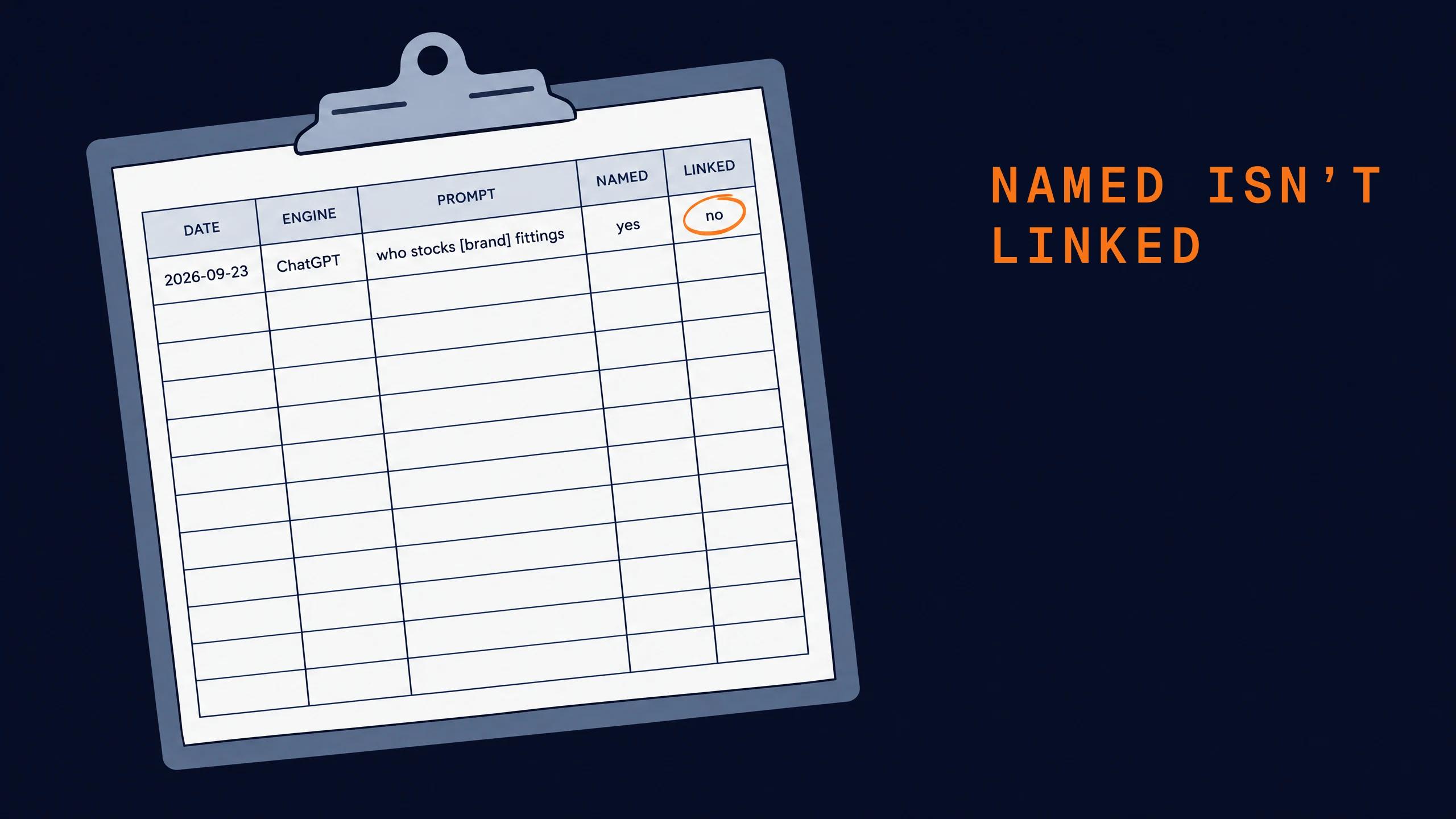
| Linked | Yes or no | The valuable one. A link means the buyer can act without typing anything else, and it moves independently of being named. |
| Where you appeared | First source, mid-answer, or a footnote at the end | Being the source an answer leads with is a different outcome from being fourth in a list nobody scrolls to. |
| Who else was named | Every other company in the answer | The column people leave out and later wish they had. Knowing you were absent is useful. Knowing who was there instead is actionable. |
Here is the header row, if you want to paste it straight into a sheet:
Date | Engine | Prompt (verbatim) | Named? | Linked? | Position in answer | Other sources named
One thing to be clear about: this is our proposal, not an industry standard. No standard exists. We arrived at seven columns by asking what each one would have told us that the others could not, and dropping the rest. If you find an eighth that earns its place on your catalog, add it. Storing the full answer text alongside the row is the most common eighth, and it is worth the space.
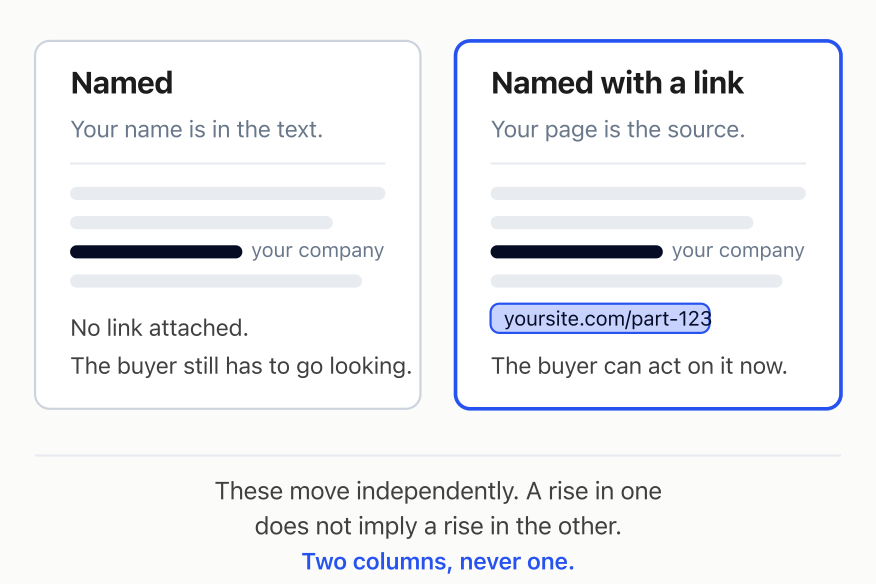
Two different outcomes. Two columns, never one.
That split is the reason the log has two yes-or-no columns instead of one. An answer can name you and then send the buyer somewhere else for the detail. It can also quote one of your pages without naming the company that published it. Our glossary covers mention rate against citation rate if you want the distinction in more depth, and the entry on an LLM citation covers what the engines are actually attaching.
How often to run it
Monthly, for most industrial distributors. But the reasoning matters more than the number, because the reasoning is what tells you when to break it.
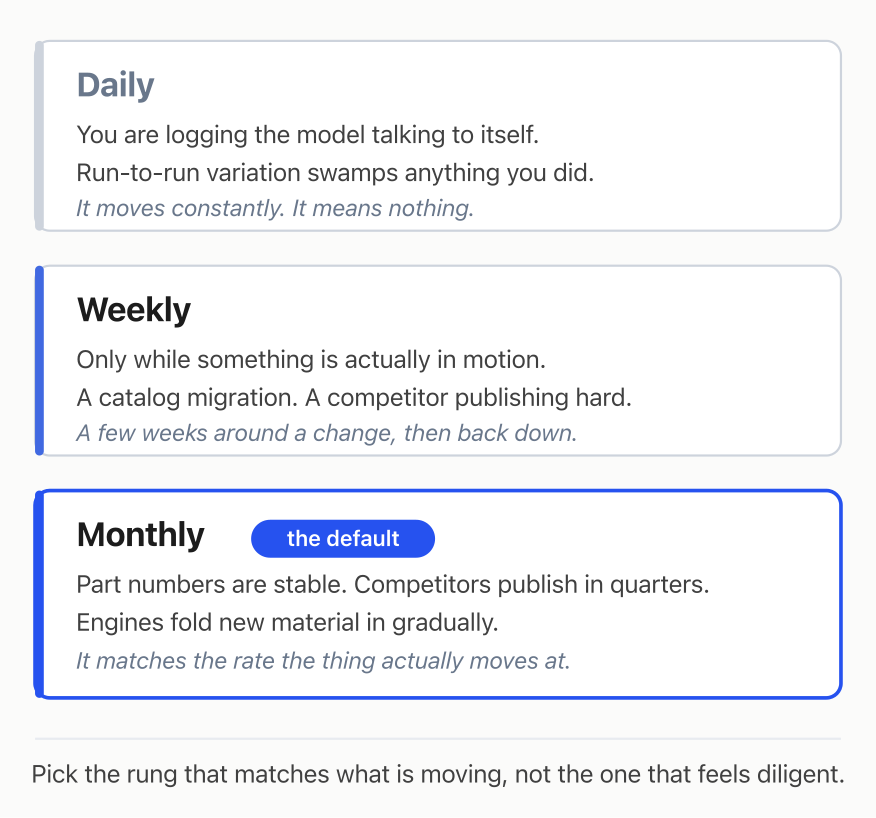
Pick the rung that matches what is actually moving.
Daily loses. Ask an engine the same question twice and you can get two different answers. A daily log fills up with the model's own variation rather than with anything you did. You end up with a chart that moves constantly and means nothing. Worse, it looks like data.
There is measurement on how fast that surface churns. Ahrefs tracked more than 43,000 keywords and found that only 54.5% of cited URLs survive from one AI Overview update to the next. The substance of the answers stayed almost identical even so. That is Google's AI answers rather than ChatGPT, but the shape is the same: nearly half the sources rotate without the answer meaning anything different. Log daily and you are mostly recording that rotation.
Weekly is the active-push cadence. When something is genuinely in motion, weekly is the right resolution. A catalog migration, a run of new spec pages, a competitor publishing hard against your categories. Weekly for a few weeks around a change, then back down.
Monthly is the standing default. A low-volume industrial term set does not turn over fast. Your part numbers are stable, your competitors publish in quarters rather than days, and the engines fold new material in gradually. Monthly matches the rate at which the thing you are measuring actually changes. HubSpot lands in the same place, recommending that you review citation and mention tracking monthly at a minimum.
What changes it: the size of your set, and whether anything is in flight. Thirty questions once a month is an hour of work. Two hundred questions monthly is a job, and at that size you either cut the set or stop doing it by hand.
What the log is actually for
Two jobs. Everything else the log does is a side effect of these.
Proving movement over a quarter. One month of rows tells you almost nothing. Three months of the same questions, asked the same way, tells you whether the work you did in between landed. That is the only comparison available to you, because there is no external number to measure against. Your last quarter is the benchmark.
Catching the thing you would otherwise find out late. This is the one that earns the spreadsheet. A competitor starts publishing cross-reference tables against the lines you carry. Three months later, the answer to a question about your own part numbers names them and not you. If you were logging who else appeared, you saw it in the second month, while it was still a content problem. If you were not, you find out when a customer mentions it, and by then it is a catch-up problem.
That second job is why the last column is not optional. It is also why the log beats a score. A number that went down tells you something is wrong. A log tells you who.
Want a sense of what your rows add up to? Our AI visibility calculator takes how often you were named and how often you were linked and turns them into what they mean across a whole question set. Useful once you have a month of rows and want to know whether they are worth anything.
When the spreadsheet stops being the right tool
A spreadsheet is the right tool for longer than most people expect. Thirty questions, one engine, once a month is about an hour. That hour is not wasted, because you read every answer while logging it.
It stops working when the set gets wide. Several hundred benchmark prompts across four engines, monthly, is no longer a spreadsheet job. Software exists for that, and there is a crowded market of it. We are not going to tell you which to buy, because the category changes monthly and the right answer depends entirely on how many questions and engines you actually need.
What we will say is that building the manual version first is worth doing even if you know you will outgrow it. It teaches you which questions matter, and a month of reading answers by hand makes you far better at judging a tool than any comparison table will. Most people who buy first end up with a dashboard nobody opens.