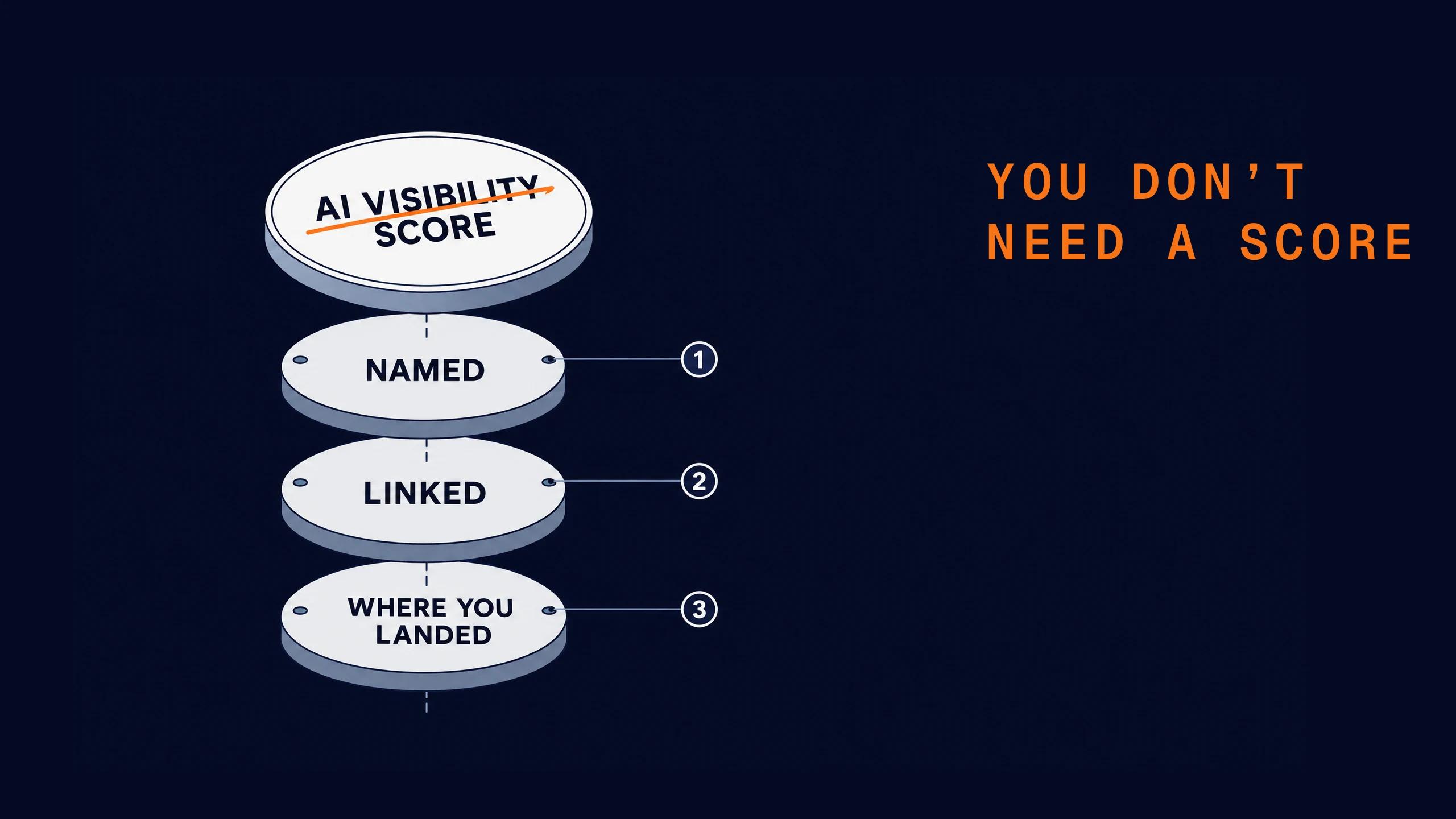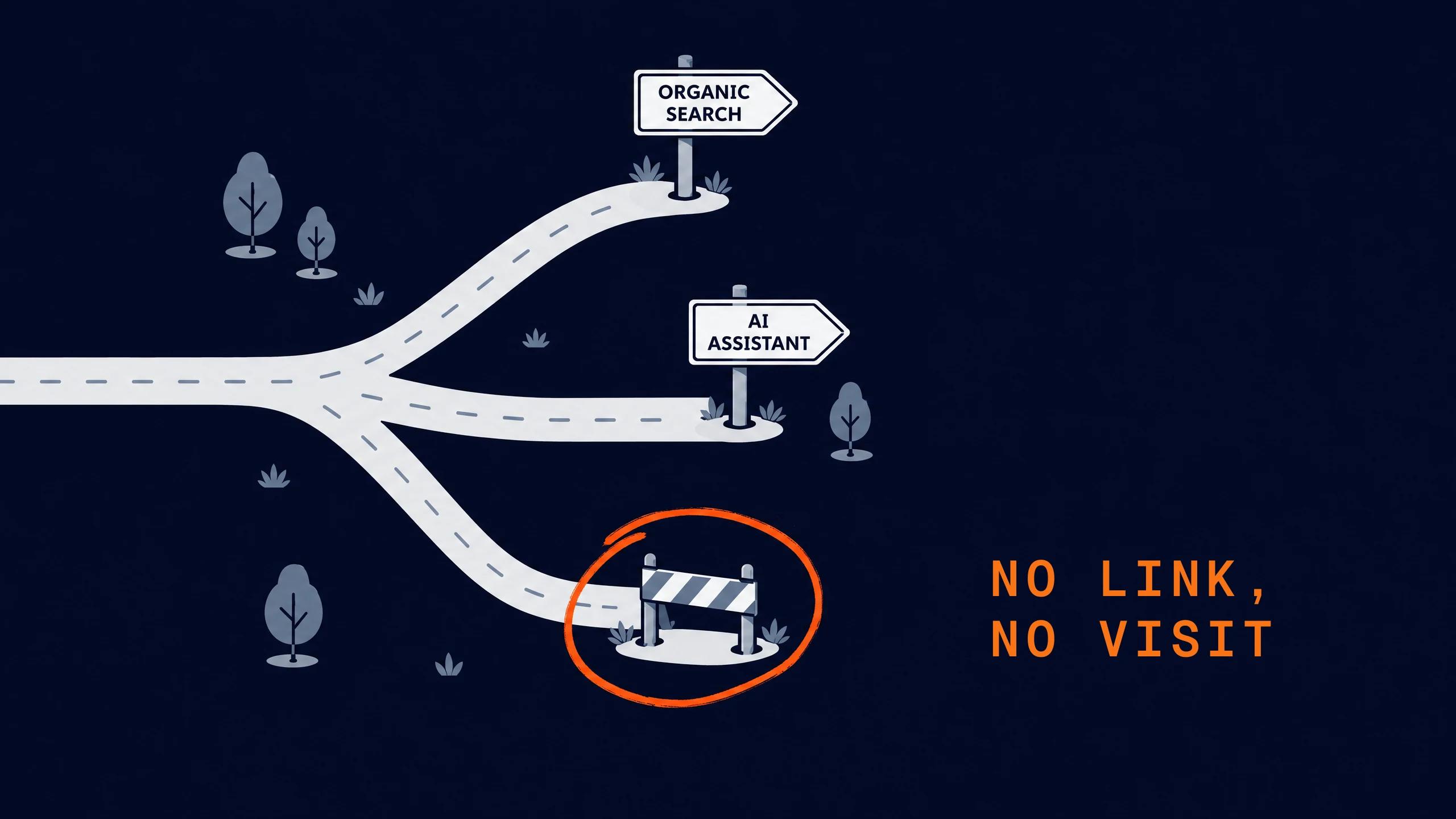
Short answer: not from one report. Your analytics has an AI Assistant channel now, but Google files its own AI Overview clicks under organic search. And a mention with no link never becomes a visit at all. So you go and ask the engines yourself. A fixed list of questions, run on a schedule, written down.
Why you cannot answer this from one report
Go and ask ChatGPT who supplies a part you stock. Say it names you, and the buyer clicks through. That visit has to show up somewhere, surely.
Some of it does show up. Not the part you most want.
There are three different things people mean by "AI search sent me someone," and they meet three different fates inside your reports. The first is a click out of a Google AI Overview. The second is a click out of a chat assistant. The third is someone reading your name in an answer, not clicking anything, and calling you a week later because yours was the name they remembered.
That third one matters most to a distributor. It's also the one no report has ever shown you.
The other two are visible, in different places, under different labels, and neither label says AI. That is the whole problem. It is worth ten minutes to understand properly, because every measurement decision after this depends on it. If you have ever wondered why your direct traffic went up for no obvious reason, this is one of the usual suspects.

What Search Console actually shows you
Start with the good news, because there is some.
Google does count it. Its Search Console documentation is explicit: clicking a link to an external page in an AI Overview counts as a click, and the normal counting rules apply. Search Central adds that sites appearing in AI features are included in the overall search traffic in Search Console, inside the Web search type.
So the clicks are in there. You're not missing revenue that Google refused to record.
What you're missing is the label. There's no switch that separates AI answers from the ten blue links. And the position data goes flat: Google states that an AI Overview occupies a single position, and every link inside it is assigned that same position. Five sources in one answer, all filed at the same number.
So Search Console tells you the total went up. It won't tell you which part of that total came out of an AI answer. If you are trying to work out which report actually explains how a visit arrived, this is where that trail goes cold.
What GA4's AI Assistant channel catches
This is the part that changed recently, and it's why advice written in 2025 now reads wrong.
On 13 May 2026 Google added a native AI Assistant channel to GA4. Traffic from the assistants gets its own line instead of being scattered through referral. Google's definition is plain enough: AI Assistant is the channel by which users arrive at your site from sources like ChatGPT, Gemini, Deepseek, Copilot, or Grok.
Useful. Also partial, in four specific ways.
The recognised list moves. It's already changed once since launch, and an assistant that isn't on it lands in referral instead. The same source can split across several channels at once, depending on whether the medium survived the trip. Clicks opened inside an assistant's own in-app browser tend to lose the referrer, so the source is kept and the medium is lost. And the channel only counts forward from the day it switched on, so there's no history to compare against.
Then there's the one that matters most. Read Google's own definition of the neighbouring channel: organic search is how users arrive via non-ad links in organic search results, including Google's AI Overviews and AI Mode. Google's largest AI surface is documented as organic search. It'll never appear in your AI channel, by design, no matter how long you wait.
That single sentence is the reason tracking AI visibility is still a manual job in 2026.
Being mentioned is not the same as being cited
Here's the distinction the rest of this depends on, and it's the one most people skip.
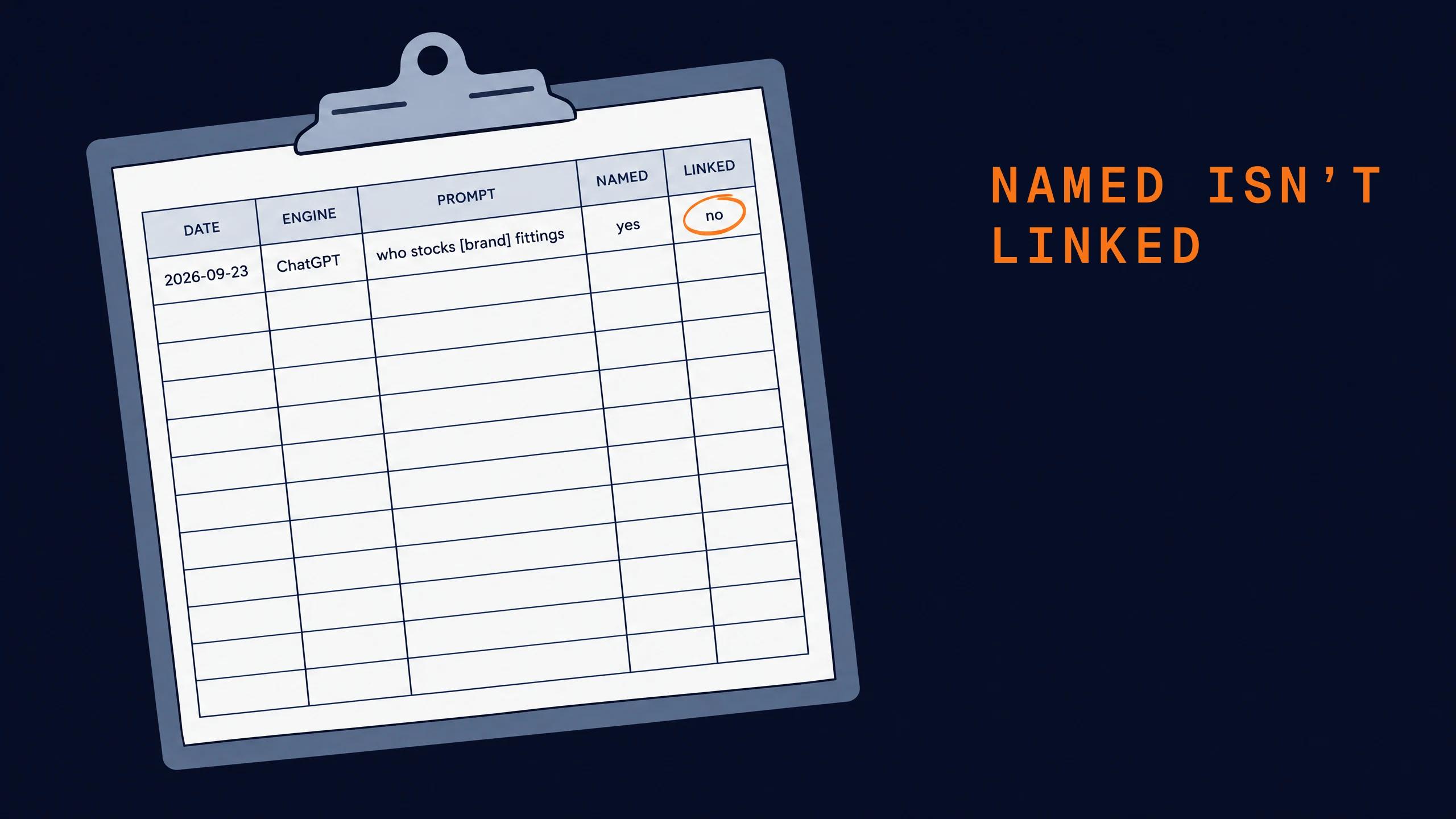
An engine can mention you: name your company in the answer, with no link. Or it can cite you: name you and link the page it drew from. Those are different events with different consequences, and the gap between them has a name — mention rate versus citation rate.
A citation can send a visit. A mention can't. But a mention still does work.
Think about how your buyer actually behaves. A maintenance manager asks an assistant who carries a discontinued seal in the Midwest. The answer names four companies. They click none of them. They type the one they half-recognise into Google, or they pick up the phone. You just got a call with no trail attached to it, and your reports will file that as direct or branded search.
Counting those two separately, run after run, is what AI citation tracking actually means. So the honest position is this. Your analytics measures the citations, badly. It doesn't measure the mentions at all. And for a distributor, the mentions are where a lot of the value sits. Your buyer is not browsing. They are sourcing a part and they want a supplier name.
What each instrument can and cannot see
Four ways to look at this, and every one of them is blind to something. Worth knowing which, before you lean on any of them.
| What you use | What it can see | What it cannot see |
|---|---|---|
| Your site analytics | Visits from the named assistants, labelled since May 2026 | Google AI answers (filed as organic), app clicks with no referrer, every mention |
| Search Console | That the clicks happened and are in the totals | Which ones came from an AI answer. True position, which flattens to one number |
| A manual prompt log | Whether you were named, whether you were linked, and how that moves week to week | Anything you did not think to ask. What happened on the days you did not run it |
| A paid tracker | The same thing as the log, more often, across more engines, without your time | The same blind spots, plus whatever its own question set leaves out |
Notice the pattern. The two instruments you already own are the two that can't answer the question. The one that can is the one nobody sells you, because it's free. More on how AI search decides which sources to name if you want the mechanism behind the answer itself.
The method you can run this week
You don't need to buy anything to get a first reading. You need a list, a habit, and somewhere to write it down. An afternoon to set up, twenty minutes a week after that.
- Write down twenty questions a buyer would actually ask. Not your product names. Use the words someone reaches for when they have a problem and no supplier yet. A cross-reference for a discontinued part. Who stocks a spec in your region. What to run when a line is down. These are your benchmark prompts. The list is the measurement, so spend real time on it.
- Pick two engines and stop there. Whichever assistant your customers mention, plus Google. Two is enough to see movement. Five is enough to make you quit by week three.
- Run the list the same way every time. Logged out, fresh session, same region, same wording. Change the method and you've thrown away your own baseline.
- Record three things per question. Did an AI answer appear at all. Were you named. Were you linked. Three columns, yes or no, nothing cleverer than that.
- Date the sheet and put it away. A single run is a snapshot, not a measurement. It only gets useful when there's a second one to hold it against.
- Re-run it on the same day next week. Same list, same method. The number you care about is the difference, not the level.

Once you have two or three runs, you will want to know what the numbers are worth against the size of your market. Our AI visibility calculator does that arithmetic, and it takes the same three columns you have been filling in.
How often the answer changes underneath you
One run tells you almost nothing, and here's the evidence for why.
Ahrefs found that AI Overview content changes around 70% of the time, and the sources it cites change about 46% of the time. Roughly half the citations you record today will be different when you look again. Not because you did anything. Because the answer regenerated.
The same Ahrefs research found that 99.2% of the searches that trigger an AI answer are informational. That's worth knowing before you build your list. The AI answer is showing up on "how do I", "what is", "what replaces" — not on a raw part number. Your catalog pages are not where this game is played. Your explanatory pages are, which is why what counts as a citation is worth pinning down before you start counting them.
So treat a single reading the way you'd treat one day's counter sales. It's noise until you have a run of them. That's the honest argument for doing it by hand first: you learn what moves and what's just the weather, and nobody can sell you that.